

Dental Implants & Replacements
Advanced Tooth Replacement Options in Rochester, NY for Lasting Function and Confidence
Does it sound like you?
Uncomfortable eating with chewing only on one side, avoiding crunchy foods, if you have a denture - feeling it moving when you talk or eat, covering your mouth when talking or smiling, noticing changes in your facial shape with a sunken appearance, having digestion issues, noticing neighboring teeth shifting causing a change in bite.
At Contemporary Dentistry, dental implants and tooth replacement solutions are designed to restore more than just your smile—they help rebuild strength, function, stability and overall oral health. Whether you are missing one tooth or several, our personalized approach ensures long-term, natural-looking results.


Dental Implant Solutions
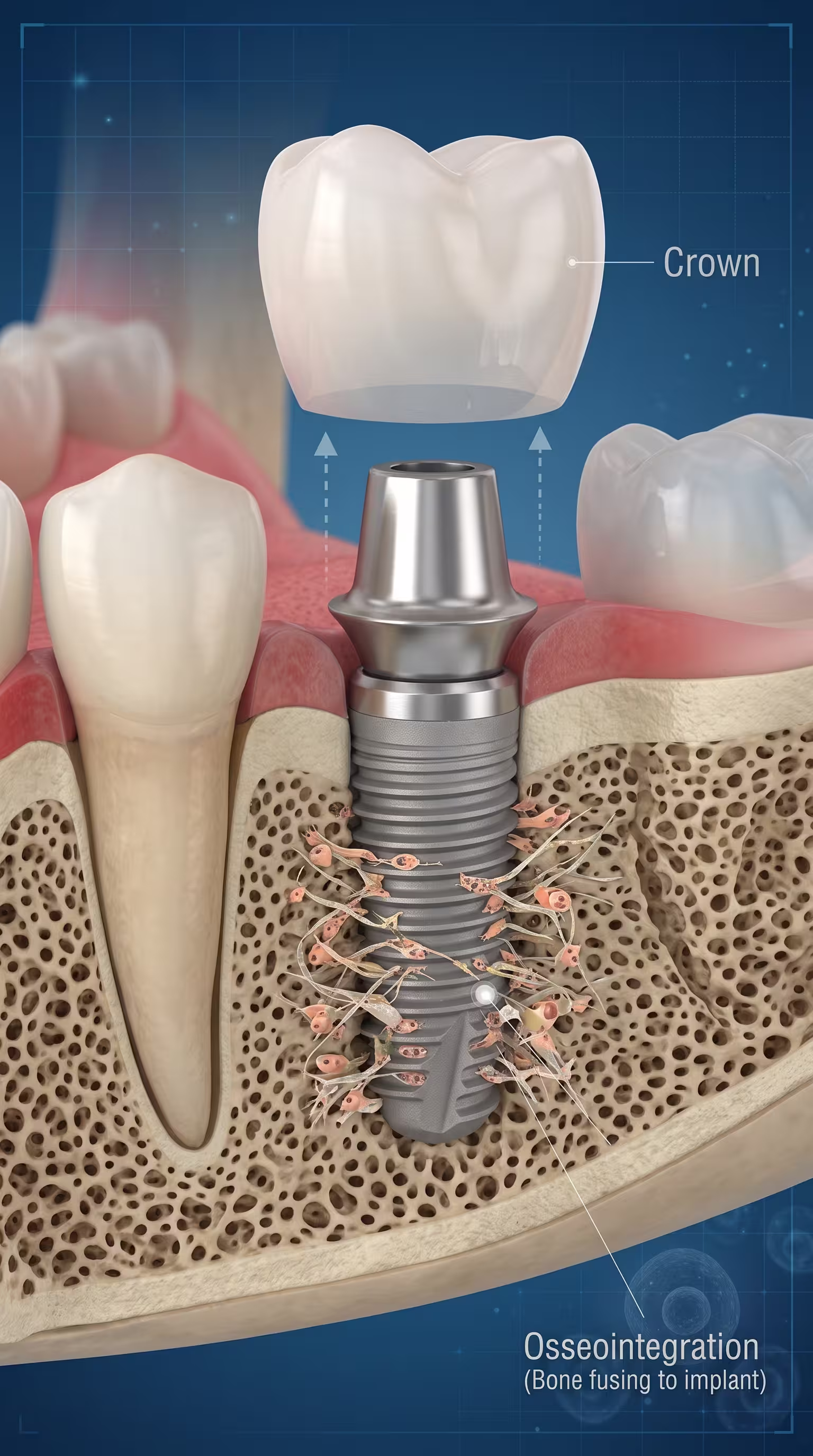
Missing teeth affect people in very different ways. Sometimes it's the functional inability to property chew food. Sometimes it is a visible gap between teeth that makes the person uncomfortable and embarrassed. Sometimes, it is the moving and shifting dentures making it hard to eat or talk. While there are other traditional restorative methods, like dental bridges, sometimes, especially when there is healthy bone and gum structure that could be preserved and reused, dental implants become the preferred choice, from both the functional and aesthetic standpoint. Dental implants are one of the most advanced and durable options for replacing missing teeth. They function like natural tooth roots, providing a stable foundation for crown and denture restorations.
Our implant services include:
Implants are designed to integrate with your jawbone, offering long-term support and stability. This process is called osseointegration (pronounced "oss-ee-oh-in-tuh-GRAY-shun"). It’s the biological healing process, in which the jawbone grows onto and bonds with the dental implant’s surface, creating a stable foundation for the replacement tooth.
Why Replacing Missing Teeth Matters
Missing teeth can affect more than appearance. Without proper treatment, gaps in your smile can lead to shifting teeth, bone loss, and changes in your bite.
Tooth replacement helps:
Restore proper eating & speaking
Restore proper biting, chewing and speaking function
Maintain facial structure
Maintain facial structure and jawbone health
Prevent neighboring
Prevent neighboring teeth from shifting
Improve comfort
Improve overall comfort and confidence
Support long-term health
Support long-term oral stability
Early evaluation through a dental exam can help determine the best solution for your situation.
A Biologic Approach to Tooth Replacement
Our approach to implants and restorations aligns with our holistic philosophy. We prioritize materials and techniques that support both oral and overall health.
This includes:

Materials
Use of biocompatible materials
Minimally Invasive
Minimally invasive surgical techniques when possible
Careful planning
Careful planning for long-term success
Integration
Integration with your overall health goals
Our goal is to provide solutions that are not only effective, but also supportive of your overall well-being.
What to Expect During Treatment
Your tooth replacement journey begins with a comprehensive consultation and personalized treatment plan.
Throughout the process, you can expect:
- Detailed evaluation and imaging for precise planning
- Clear explanation of your options and timeline
- Step-by-step guidance from start to finish
- Ongoing support during healing and restoration
For added comfort, we also offer sedation dentistry during certain procedures.


Maintaining Your Results
Proper care is essential to ensure the longevity of your dental implants and restorations. Contemporary Dentistry will be there with you every stop of the way, during and after the procedure to ensure our treatment offers a positive long-term clinical outcome. We will work with you as a team and encourage you to do what you need to do to ensure your implant continues to perform well for many years.
We will recommend:

Regular dental cleanings and exams

Consistent at-home oral hygiene

Routine monitoring of your restorations
Following personalized care instructions
With proper maintenance, many tooth replacement solutions can last for years or even decades.
Frequently Asked Questions About Dental Implants Answered By Our Expert Dentists


Why would I want a dental implant, as opposed to another type of restoration, such as a bridge or a partial denture?
Before we provide a more in-depth answer, let's put it simply - when you are missing a tooth and there is a gap between teeth, a dental implant is most often the best choice when you want the closest substitute to a natural tooth. All other considerations aside, typically, nothing beats a dental implant in terms of stability, comfort, long term durability, and jawbone and adjacent teeth's health.
Now that we have this basic understanding, let's dive deeper. Yes, there are alternatives to a dental implant. Some of them are quite viable and practical. When a single tooth or a small number of contiguous teeth is missing, a bridge or a partial denture may be considered. However, one must be aware of their disadvantages. A bridge depends on the adjacent teeth and their health. At best, it will require those teeth to be prepped to serve as the anchors on both sides of the bridge. Those healthy teeth will sustain additional mechanical stress and wear, as part of their function. It may be more difficult to maintain hygiene around the area of the bridge. The jawbone under the bridge, where there is no natural or implant tooth structure, will sustain bone loss overtime, causing the adjacent teeth to shift over time. This sometimes requires additional adjustments or a complete rebuild of the bridge. In some cases, a new bridge may no longer be a viable option, and neither may be going back to the implant option because of the already sustained jawbone loss.
Many of the same adverse factors affect the patient choosing a partial denture as an alternative. The stability may be compromised, more daily maintenance will most certainly be required, jawbone loss will most certainly continue and there will continue to be mechanical stress, irritation of the gum tissue and other unwanted impact on the adjacent teeth and gum. Dental implants, on the other hand, function exactly like a natural tooth. They require the same type of hygiene maintenance as a natural tooth would, they do not require prepping and losing any enamel structure of the adjacent teeth, as they do not impact the adjacent teeth in any way. Lastly, the natural mechanical pressure of the osseointegrated dental implant post on the jawbone allows the bone structure to keep its strength and shape indefinitely.
What does the dental implant process look like? Walk me through, step by step.
The answer to this question lies largely in the amount of work that needs to be done. Would we need to replace one missing tooth or multiple teeth? What is the location and spread of the missing teeth in your mouth? What is the condition of the remaining teeth, if any, in your mouth? What is your overall health? What is your timeline and what are your long-term objectives? What is your budget? All of these questions will help us decide between the number of implants you may need and whether they will be followed by crown restorations, or implant-supported bridges or dentures. But let's assume you need a single dental implant. This will give you a rough idea that you can then extrapolate to more dental work that may need to be done. Although, keep in mind that if more than one dental implant is required, we often can work on them simultaneously or at least asynchronously, thereby shrinking the overall treatment time-frame.
So, you need an implant and a crown restoration. A typical single dental implant takes several office visits over roughly 3-9 months, with the surgical appointment itself usually taking about 60-90 minutes. The longest part is not the surgical procedure. It is the healing process, while your jawbone fuses to the implant post.
Your first visit will be a consultation where we would discuss and plan our work, based on your objectives, your overall health condition, your jawbone, gum and other teeth's condition, your bite and other factors. We would likely need to take X-Rays and/or 3D scans to assess your condition further. We will also discuss your comfort during and after the procedure and will outline all of the options with respect to anesthesia and sedation. We will also be very transparent with you and present you with the cost of every option. Our patient experience team is amazing and they will help you navigate through the decision-making process from both the clinical and the financial sides, answering any questions you may have along the way. You should expect a clear, written treatment plan, outlining what will be done by the dentist, the implant system and the restoration type and material that will be used, the anticipated number of visits and their timeline, and the anticipated cost. If you smoke, have diabetes, take certain medications, have inflammation, or have significant jawbone loss, those factors may change the plan or the timeline. For example, significant jawbone loss may be pre-faced by a bone grafting surgical procedure that would rebuild lost or thin jawbone, so that there is enough volume and density to place a dental implant securely.
Once the treatment plan is put in motion, we will begin to execute on it in multiple office visits.
We will first extract the damaged tooth, if it is still present. If the remaining socket needs more bone, we will place a bone graft, in which case the site will be allowed to heal for several weeks or months first. Your experience will be comfortable, as these procedures are typically complemented with local anesthesia and sedation. If oral conscious or IV sedation is administered, you will be asked to be driven to and from the appointment by someone else.
The next step will be the implant placement surgery, performed by a board-certified periodontist. We will make a small incision in the gum, if needed, prepare a precise channel in the jawbone and insert the implant post, which is much like a screw that is driven into the channel. At the end of the surgery we may place a healing cap or close the gum with sutures. Your experience will be comfortable, as this procedure is accompanied by both local anesthesia and some form of sedation. Once the procedure is completed, you will be given ample time to recover comfortably in our recovery room. Once you have recovered from sedation, we will then give you post-operative instructions to ensure you follow a protocol that will yield the best healing results. You may be prescribed medication for pain control and, in some cases, antibiotics. This appointment, assuming a single implant placement, would typically last 60-90 minutes. Since most likely some form of oral conscious or IV sedation will be administered, you will be asked to be driven to and from the appointment by someone else. Once at home, you will experience numbness from anesthesia for several hours, then mild-to-moderate soreness. Swelling and bruising may ensue for the next 24-72 hours. That is normal. There may also be some minor bleeding for the first few hours following the procedure, which is also normal. For the first few hours after the procedure, you may be asked to apply cold compresses to reduce swelling. You will be asked to bite gently on a gauze and avoid spitting, sucking from a straw, smoking, rinsing and performing physical exercise or strenuous physical activity for the first 24 hours. Also, for the first several days or weeks you will be asked to eat softer, gentler foods and avoid biting or chewing directly on the surgical area.
The next phase includes healing and osseointegration - the process of jawbone fusing to the inserted post. Depending on your overall and oral health condition, this may take 3-9 months. At this stage, natural bone tissue grows onto and around the implant surface. This is what eventually makes the implant stable enough to support a crown, a bridge or a denture. You may have a few follow-up visits during this period to first remove any sutures and then periodically assess the healing process. Some additional X-Rays may be needed to monitor and assess the jawbone's fusion progress. The implant may sometimes integrate with the lower jaw faster than with the upper one. That is why the 3-9 months estimate is such a wide time range.
The next phase involves placing an abutment - a small attachment that goes on top of the implant post that will be used to hold the final restoration. Once the abutment is placed, we will 3D scan your entire jaw to digitally model your crown, bridge or denture. We may also take some impressions of your jaw. This process is not invasive and you will not need much more than a local anesthesia, but we will do everything necessary to keep you comfortable.
The final restoration will then take 2-4 additional weeks, where one of our carefully selected dental labs will produce a crown, bridge or denture, based on our biocompatibility holistic guidelines, to ensure no toxicity and long-term durability.
The final visit will involve placing and adjusting the restoration. This is a fairly straightforward and minimally invasive process. Your appointment should typically last about 60 minutes. Again, you may be given local anesthesia, but we will be there for you with any additional comforting amenities or sedation options, as needed. Remember, any time sedation is administered, you will be again asked to be driven to and from the appointment by someone else. So, keep that in mind, when planning.
Are dental implants permanent?
In most cases they are, although, like everything in dentistry, it is not guaranteed and depends on many factors. But many of those factors are in patient's control. We first evaluate each case for viability for a dental implant treatment based on a number of factors, such as the patient's overall health profile, the profile of their oral health, particularly their gum and jawbone health. We then only recommend and place implants, when clinically viable. When we do place implants, we do expect them to serve indefinitely, although sometime in the future the restorations on top of those implants may require additional treatment or re-work. Every patient's case is different, but we carefully monitor the jawbone, gum and overall oral health at every routine hygiene and exam visit.
Do dental implants ever fail?
Dental implants do, sometimes, fail. Sometimes, they fail early after they are placed, if they do not fuse properly with the bone. They can also fail later from peri-implant gum disease, infection, poor oral hygiene, smoking, uncontrolled diabetes, grinding, or insufficient jawbone. As you can see, some of these factors are in patient's control and we highly encourage good lifestyle habits that may prolong the implant's lifespan. When an implant does fail, depending on the causes and how far along it was in the jawbone osseointegration process, we may attempt to re-implant the post. This procedure is also not guaranteed to be successful and also largely depends on the causes of the original failure. While we maintain a minimally invasive practice philosophy, we always look for the most optimal paths to long-term, sustainable oral health, taking into consideration all of the important factors.
Am I a candidate for a dental implant?
This largely depends on your health history, your current overall and oral health profile and your goals and objectives for maintaining long term oral health. Do you want a quicker, less durable solution? Or do you want something more permanent, akin to a natural tooth? The choice will be yours. We will be there to help you make it.
What if I am missing multiple teeth?
Missing multiple teeth introduces some additional considerations. Are the gaps of missing teeth adjacent to each other, creating a contiguous area, or spread out in between functional teeth? What is the health condition of those teeth that you still have? How long have you been missing the teeth and is there sufficient jawbone structure to support one or more implants? Sometimes, multiple independent implants and restorations may be the best option. Sometimes, the right answer may be an implant supported fixed bridge covering a larger contiguous gap. Sometimes, it may be an implant supported denture that may be the best solution. This is something we will discuss during your first consultation appointment.
Are tooth replacement procedures painful?
Implant placement is a surgical procedure. As such, it requires that all pre-surgery, surgical, and post-surgery protocols be strictly followed. One of those guidelines is making the patient most comfortable during and after the procedure. Our comfort, anesthesia and sedation services are some of the most sophisticated you will find in Rochester, NY, as we offer a slew of comforting and relaxing amenities and a broad array of targeted local anesthesia and sedation options, ranging from mild sedation with nitrous oxide, to moderate conscious sedation with oral prescription medication, to deep sedation delivering the sedative medication intravenously (IV). We also offer a comfortable on-site recovery space where patients can wait and relax as their anesthesia wears off, while we closely monitor and comfort them.
Is dental implant maintenance difficult?
Not at all. Not any more difficult than carrying for a natural tooth, anyway. If we can assume that you would plunge into the decision to restore your missing tooth with an option that delivers results that are closest to a natural tooth, it would probably be safe to also assume that you would be willing to care for it as you would've for the natural tooth that's missing. Regular brushing and flossing should be enough to do the job. Of course, we'll be here for your regular hygiene and exam appointments and will assess your implant and restoration, the jawbone, the gum and the adjacent teeth's health frequently.
Are dental implants covered by insurance?
The answer to this question is complicated. The short of it is that it depends. Dental implants are not fully covered by most traditional dental insurance plans. They are often classified as elective or cosmetic procedures. However, some newer or more comprehensive dental plans may offer partial coverage, up to 50% of the cost, after you meet your deductible, up to an annual maximum benefit cap. Some policies differentiate between the surgical insertion of an implant post, abutment and the crown restoration. For instance, they may cover only the crown restoration, in full or in part. Yet other insurance providers may "downgrade" your claim, paying only for what they would normally cover, had it been a cheaper alternative, like a traditional bridge or a partial denture.
On the other hand, some medical insurances may cover the implant surgery, and not the crown restoration that goes on top of it, when the tooth loss is a result of trauma from a physical accident or a systemic disease, such as oral cancer. We have expert insurance claims professionals on staff and we can quickly verify eligibility and submit all insurance claims, where applicable. This way our patients never miss an opportunity to get reimbursed by their insurance.
We also offer no- and low- interest financing, to cover the shortages from any insurance or out-of-pocket payments. Our "access for all" practice philosophy dictates that we work with every patient to find the best ways for them to achieve their oral health objectives.
We combine advanced dentistry with a holistic, biologic approach that focuses on your overall health—not just your teeth.
Schedule Your Consultation
Restore your smile with advanced tooth replacement solutions tailored to your needs. Call (585) 244-3337 or visit our contact page to schedule your appointment today.